


Restaurant Cleaning Equipment Guide: Essential Tools for Commercial Kitchens
Table of Contents
ToggleA complete guide to the commercial machines, specialized tools, chemicals, and wastewater-recovery systems used to clean demanding restaurant and food-service environments.
What Is Restaurant Cleaning Equipment?
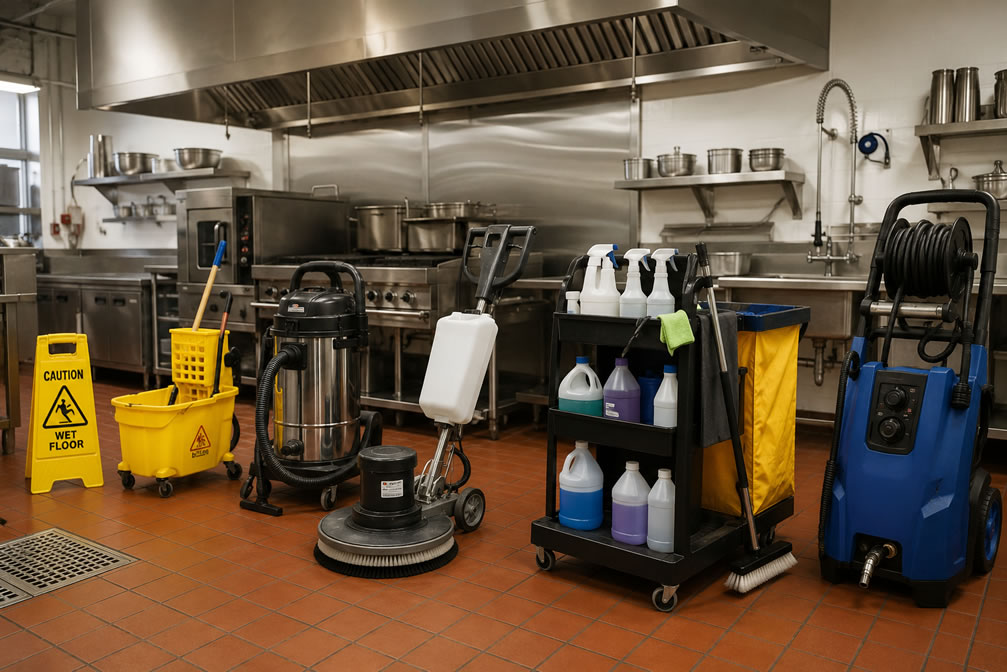
Restaurant cleaning equipment includes commercial-grade machines, specialized tools, chemicals, and wastewater-recovery systems used to remove grease, food residue, carbon deposits, soil, sludge, smoke residue, and other contaminants from food-service facilities.
The most important equipment categories include hot-water pressure washers, commercial steam cleaners, automatic floor scrubbers, industrial wet vacuums, hood-cleaning systems, chemical foam applicators, rotary surface cleaners, and non-abrasive stainless-steel tools.
Professional equipment improves cleaning consistency, reduces manual labor, protects restaurant surfaces, supports inspection readiness, and helps maintain safer commercial kitchens. The correct equipment depends on the contamination level, surface material, kitchen layout, cooking volume, drainage conditions, and required cleaning result.
Essential Commercial Restaurant Cleaning Equipment
Restaurant Cleaning Equipment at a Glance
| Equipment | Best Application | Primary Function |
|---|---|---|
| Hot-water pressure washer | Durable floors and exterior surfaces | Removes grease, oil, and food residue |
| Commercial steam cleaner | Cooking equipment and detailed areas | Loosens grease and embedded buildup |
| Automatic floor scrubber | Kitchen and dining floors | Scrubs surfaces and recovers dirty water |
| Industrial wet vacuum | Deep cleaning and spill recovery | Extracts wastewater, sludge, and debris |
| Hood-cleaning system | Hoods, plenums, fans, and ducts | Removes accumulated exhaust grease |
| Foam applicator | Walls, floors, and equipment | Improves chemical coverage and contact time |
| Rotary surface cleaner | Concrete and large hard surfaces | Produces consistent pressure-washing coverage |
| Stainless-steel tools | Appliances, tables, and fixtures | Cleans finished metal without abrasion |
Who Uses Commercial Restaurant Cleaning Equipment?
Commercial cleaning equipment is used across food-service environments with different cooking methods, traffic levels, operating hours, floor materials, and ventilation systems.
Restaurants and QSRs
- Full-service restaurants
- Quick-service restaurants
- Fast-food properties
- Pizza restaurants
- Steakhouses
- Barbecue restaurants
Hospitality and Production
- Hotel kitchens
- Ghost kitchens
- Commissary kitchens
- Catering facilities
- Breweries
- Bakeries
Institutional Food Service
- School cafeterias
- Hospital kitchens
- Corporate dining facilities
- Stadium concession areas
- Senior living dining facilities
- Cafés and coffee shops
Each facility produces a different contamination profile. Cooking methods, operating hours, food volume, floor materials, ventilation design, and customer traffic determine which cleaning systems are required.
Hot-Water Pressure Washers Remove Heavy Grease Faster
Hot-water pressure washers remove grease, cooking oil, food residue, gum, soil, and environmental contamination from durable restaurant surfaces.
Heat helps soften greasy deposits. Controlled water pressure separates contamination from the surface so it can be collected, rinsed, or recovered.
Common applications
- Grease-resistant kitchen floors
- Dumpster pads
- Loading docks
- Trash enclosures
- Drive-thru lanes
- Concrete sidewalks
- Exterior service areas
- Durable masonry surfaces
Commercial Steam Cleaners Reach Detailed Kitchen Areas
Commercial steam cleaners use heated vapor to loosen grease, food residue, and buildup around cooking equipment and narrow access points.
Where Steam Is Used
- Commercial oven exteriors
- Fryer exteriors
- Grills and cooking lines
- Stainless-steel equipment
- Tile and grout
- Equipment joints
- Wall edges
- Detailed preparation areas
Critical Operating Conditions
Steam can reach seams, hinges, corners, equipment legs, casters, joints, and edges that are difficult to clean with larger machines.
Steam cleaning does not automatically sanitize every surface. Cleaning and sanitizing remain separate procedures when required by the restaurant’s sanitation program.
Electrical safety, surface compatibility, ventilation, and manufacturer instructions must be reviewed before treatment.
Automatic Floor Scrubbers Improve Grease Removal
Restaurant floors accumulate grease, food particles, liquids, soil, and cleaning residue throughout the operating day.
An automatic floor scrubber applies cleaning solution, agitates the floor with brushes or pads, and recovers dirty water in one controlled process. This provides more consistent results than repeatedly mopping contaminated water across the floor.
Recommended Areas
- Commercial kitchens
- Food-preparation rooms
- Storage areas
- Service corridors
- Employee workspaces
- Dining rooms
- High-traffic entrances
Correct Brush Selection
The brush or pad must match the floor material. Aggressive brushes may damage softer flooring, while weak pads may fail to reach grease trapped in textured tile or concrete.
Professional floor cleaning may also require edge brushes, degreasers, wet vacuums, squeegees, and detail tools.
Industrial Wet Vacuums Control Wastewater and Sludge
Wet vacuums extract wastewater, loosened grease, sludge, food debris, and cleaning solution after scrubbing, rinsing, or pressure washing.
Wastewater recovery is important when drains are unavailable, water cannot enter adjacent areas, or the floor must return to service quickly.
- Floor scrubbing
- Pressure washing
- Spill recovery
- Drain-area cleaning
- Grease removal
- Post-rinse extraction
- Water-damage cleanup
Hood-Cleaning Equipment Reaches Exhaust-System Grease
Commercial kitchen exhaust systems require specialized equipment because grease accumulates inside hoods, filters, plenums, fans, and ductwork. Routine surface wiping cannot reach the complete exhaust pathway.
Professional Hood-Cleaning Equipment
- Heated pressure washers
- Flexible pressure-washing wands
- Rotary duct brushes
- Chemical foam applicators
- Hand scrapers
- Inspection lights
- Fan-access tools
Containment and Recovery Equipment
- Grease-collection containers
- Containment tarps
- Plastic equipment barriers
- Wastewater-recovery systems
- Floor and appliance protection
Containment protects cooking appliances, floors, preparation areas, and nearby equipment from loosened grease, chemicals, and wastewater.
The cleaning method and frequency should reflect the exhaust-system design, cooking process, grease production, system condition, and applicable fire-safety requirements.
Degreasing Systems Improve Chemical Coverage
Commercial degreasing systems apply cleaning products across grease-contaminated surfaces.
Foam applicators are useful on vertical surfaces because foam remains in place longer than a thin liquid spray. Increased contact time allows the cleaning product to break down oily deposits before agitation and rinsing.
Pump Sprayers
Controlled application across smaller or detailed surfaces.
Foam Cannons
Extended chemical contact time on vertical and greasy surfaces.
Chemical Injectors
Consistent product distribution through compatible equipment.
Manual Agitation
Industrial brushes, extension poles, and detail tools.
Chemical selection must account for the contaminant, surface material, dilution ratio, contact time, ventilation, rinsing requirements, and food-service environment. Cleaning products should never be mixed unless the manufacturer explicitly permits it.
Rotary Surface Cleaners Improve Exterior Cleaning
Rotary surface cleaners attach to commercial pressure washers and distribute water through rotating spray bars. They provide more consistent cleaning across broad, durable surfaces than a standard pressure-washing wand.
Waste Areas
- Dumpster pads
- Trash enclosures
- Loading areas
Customer-Facing Areas
- Concrete sidewalks
- Exterior patios
- Drive-thru lanes
Service Areas
- Parking surfaces
- Delivery areas
- Exterior service zones
Surface cleaners can reduce visible striping and increase productivity. Correct pressure, temperature, nozzle selection, drainage planning, and wastewater control are still required.
Stainless Steel Requires Non-Abrasive Tools
Commercial kitchens contain stainless-steel preparation tables, sinks, appliances, shelving, counters, backsplashes, and hood components.
Incorrect tools can scratch the finish, leave uneven polishing marks, or damage protective surfaces.
- Microfiber cloths
- Soft-detail brushes
- Non-abrasive pads
- Controlled spray applicators
- Stainless-steel cleaners
- Low-moisture steam systems
- Soft polishing tools
Best Equipment for Each Restaurant Cleaning Task
| Cleaning Task | Recommended Equipment |
|---|---|
| Remove grease from kitchen floors | Floor scrubber, degreaser, and wet vacuum |
| Clean hood surfaces | Heated pressure washer and foam applicator |
| Clean exhaust ductwork | Rotary brushes and flexible extension tools |
| Remove wastewater | Industrial wet vacuum |
| Clean grills and ovens | Steam cleaner and carbon-removal tools |
| Clean dumpster pads | Hot-water pressure washer and surface cleaner |
| Restore tile and grout | Rotary scrubber or steam-cleaning system |
| Clean stainless steel | Microfiber and non-abrasive tools |
| Clean exterior concrete | Commercial pressure washer and surface cleaner |
| Reach equipment edges | Steam cleaner and detail brushes |
Equipment Requirements Differ by Restaurant Type
Fast-Food Restaurants
Floor scrubbers, pressure washers, degreasing systems, and frequent exhaust cleaning address high cooking volume and oil exposure.
Pizza Restaurants
Steam cleaners, hood-cleaning systems, floor scrubbers, and detail brushes control flour, cheese, grease, and baked residue.
Steakhouses and Barbecue
Heated pressure washers, carbon-removal tools, exhaust equipment, and heavy-duty degreasers address smoke, grease, and carbon deposits.
Bakeries
Commercial vacuums, steam cleaners, detail tools, and controlled floor systems manage flour dust, sugar, oils, and baked residue.
Food Trucks
Compact equipment is required because workspace, drainage, electrical clearance, and equipment access are limited.
Hotels and Commissaries
Complete equipment systems support larger facilities, multiple cooking areas, and extended operating schedules.
Commercial Equipment Versus Household Tools
| Feature | Household Equipment | Commercial Equipment |
|---|---|---|
| Intended workload | Light residential use | Repeated commercial operation |
| Grease-removal capacity | Limited | Designed for heavy contamination |
| Tank capacity | Small | Larger solution and recovery tanks |
| Heat capability | Limited | High-temperature options |
| Surface coverage | Restricted | Suitable for larger facilities |
| Durability | Consumer-grade | Heavy-duty components |
| Wastewater recovery | Minimal | Industrial extraction capability |
| Cleaning consistency | Variable | Designed for repeatable procedures |
Household tools may support minor daily maintenance. They are not designed for extensive grease, large wastewater volumes, exhaust contamination, or recurring commercial deep cleaning.
How Professionals Select the Correct Equipment
Commercial cleaning providers assess the facility before selecting machines, chemicals, brushes, and recovery systems.
- Restaurant type
- Kitchen size and layout
- Cooking volume
- Grease accumulation
- Surface materials
- Equipment condition
- Hood and duct configuration
- Access limitations
- Drain locations
- Water availability
- Wastewater requirements
- Cleaning frequency
- Operating hours
Restaurant Cleaning Equipment for Chicago Commercial Kitchens
Chicago restaurants operate in demanding conditions that include year-round cooking activity, high pedestrian traffic, winter salt, moisture, outdoor grease migration, and frequent food-service use.
Commercial kitchens in Chicago may require equipment capable of removing heavy grease, managing wastewater, cleaning exhaust systems, restoring concrete surfaces, and maintaining interior and exterior service areas.
Restaurants, hotels, commissaries, cafés, bakeries, and food-service facilities throughout Chicago and the surrounding suburbs benefit from equipment selected for local operating conditions, building access, drainage, kitchen layout, and seasonal contamination.
Professional restaurant cleaning services combine equipment selection with scheduling, containment, chemical control, wastewater recovery, and surface-specific procedures.
Common Restaurant Cleaning Equipment Mistakes
- Using residential machines for commercial grease
- Applying excessive pressure to delicate surfaces
- Using abrasive tools on stainless steel
- Selecting incompatible chemicals
- Allowing wastewater to spread or enter storm drains
- Reusing contaminated pads and brushes
- Skipping containment around cooking equipment
- Operating machines without suitable protective equipment
- Ignoring filters, hoses, tanks, and pumps
- Applying one cleaning method to every surface
These errors can reduce cleaning quality and damage floors, finishes, seals, electrical components, and restaurant equipment.
Commercial Cleaning Equipment Requires Maintenance
Cleaning equipment must be maintained to provide reliable pressure, chemical distribution, wastewater recovery, and surface agitation.
Daily Maintenance
- Empty and rinse recovery tanks
- Flush chemical lines
- Clean brushes and pads
- Inspect hoses
- Remove debris from filters
- Dry equipment before storage
Weekly Maintenance
- Inspect pumps
- Check electrical components
- Examine spray tips and nozzles
- Replace worn accessories
- Test wastewater-recovery systems
Preventive Maintenance
- Replace filters
- Service heating systems
- Inspect pressure regulators
- Replace damaged hoses
- Check motors
- Follow manufacturer schedules
Poorly maintained equipment may spread contamination, lose pressure, leave excess water, apply chemicals unevenly, or fail during a scheduled cleaning project.
When Professional Restaurant Cleaning Is Required
Restaurant employees can perform routine wiping, sweeping, mopping, and sanitation tasks. Professional cleaning becomes more appropriate when contamination exceeds the capability of daily maintenance tools.
- Grease remains after routine mopping
- Floors become slippery shortly after cleaning
- Carbon is bonded to cooking equipment
- Grease is visible inside exhaust components
- Wastewater cannot be controlled safely
- Equipment must be moved for complete access
- High-temperature or pressure systems are required
- Exterior grease affects sidewalks or dumpster areas
- Cleaning must occur outside operating hours
- Several areas require coordinated deep cleaning
Professional restaurant cleaning combines industrial equipment with trained operation, surface assessment, chemical control, containment, and wastewater recovery.
Benefits of Professional Restaurant Cleaning Equipment
Stronger Grease Removal
Heated water, steam, chemicals, and mechanical agitation remove contamination that routine cleaning may leave behind.
Faster Area Coverage
Commercial machines clean large floors, walls, equipment areas, and exterior surfaces more efficiently.
Wastewater Control
Wet vacuums, containment materials, and recovery systems prevent dirty water from spreading.
Detailed Access
Steam systems, extension tools, and specialized brushes reach seams, corners, equipment legs, and exhaust components.
Surface Protection
Correct equipment selection reduces the risk of avoidable scratches, etching, water intrusion, and finish damage.
Consistent Maintenance
Structured equipment and cleaning procedures support more repeatable results across scheduled service visits.
Equipment alone does not create an effective cleaning program. Results depend on trained operation, correct chemical use, surface assessment, containment, wastewater control, and structured cleaning procedures.
Restaurant Cleaning Equipment FAQs
What equipment removes heavy grease from restaurant kitchens?
Hot-water pressure washers, commercial steam cleaners, automatic floor scrubbers, foam applicators, industrial brushes, and commercial degreasers are commonly used to remove heavy kitchen grease.
What equipment is used for restaurant hood cleaning?
Restaurant hood cleaning commonly requires heated pressure washers, flexible wands, rotary brushes, foam applicators, scrapers, containment materials, grease-collection equipment, and inspection lights.
Why are floor scrubbers more effective than mops?
Floor scrubbers apply cleaning solution, mechanically agitate the surface, and recover dirty water. Mops may redistribute grease and contaminated water instead of extracting it.
Can steam cleaners be used on commercial kitchen equipment?
Steam can be used on compatible commercial surfaces. Electrical components, seals, finishes, and manufacturer restrictions must be evaluated before treatment.
What equipment cleans restaurant dumpster pads?
Dumpster pad cleaning commonly uses a hot-water pressure washer, rotary surface cleaner, commercial degreaser, industrial wet vacuum, and wastewater-recovery system.
What equipment removes carbon buildup?
Commercial steam cleaners, carbon-removal products, hand scrapers, and specialized brushes are commonly used to loosen and remove carbon from compatible cooking equipment.
How is wastewater handled during restaurant cleaning?
Professional cleaners use wet vacuums, recovery tanks, containment systems, and controlled disposal procedures to prevent wastewater from spreading or entering unauthorized drainage systems.
Does restaurant cleaning equipment guarantee compliance?
No. Equipment supports effective cleaning, but compliance depends on sanitation procedures, employee practices, facility condition, food handling, documentation, and applicable regulations.
Restaurant Cleaning Equipment Summary
Restaurant cleaning equipment includes pressure washers, steam cleaners, floor scrubbers, wet vacuums, exhaust-cleaning systems, degreasing applicators, surface cleaners, stainless-steel tools, and wastewater-recovery equipment.
Each system performs a specific function. Pressure washers remove grease from durable surfaces. Steam cleaners reach detailed areas. Floor scrubbers agitate floors and recover dirty water. Wet vacuums control wastewater. Hood-cleaning systems reach grease inside exhaust components.
Equipment selection must reflect the restaurant type, contamination level, surface material, exhaust design, access conditions, drainage, and cleaning objective.
Professional equipment combined with trained operation, chemical control, containment, and wastewater recovery produces more consistent cleaning, protects restaurant assets, supports inspection readiness, and strengthens long-term facility maintenance.