


Definition Block
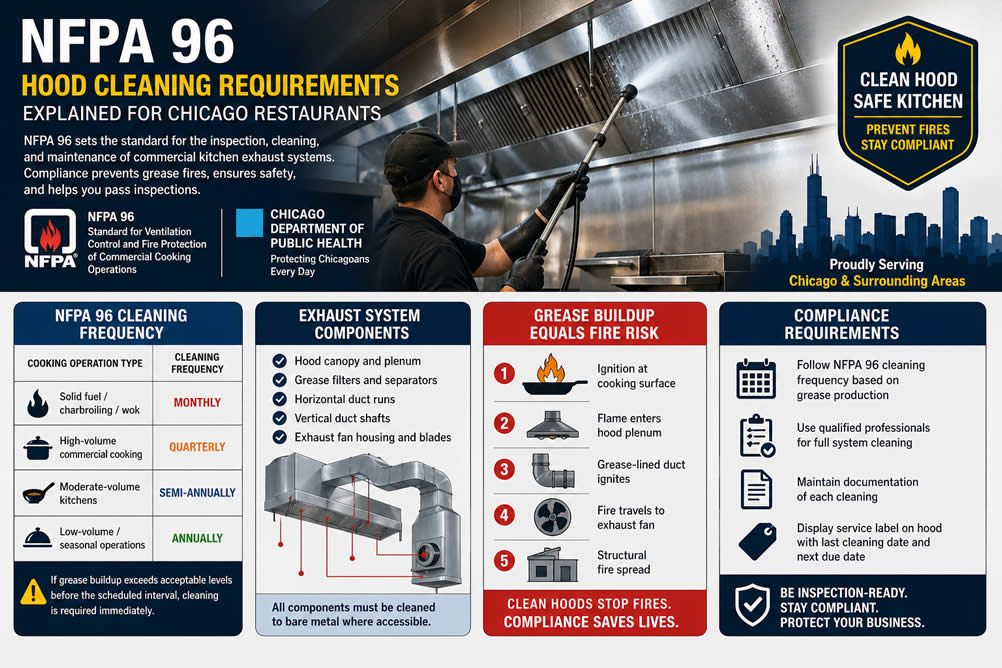
NFPA 96 requires that all commercial kitchen exhaust systems be maintained free of grease accumulation capable of ignition. This includes hoods, ducts, fans, and grease removal devices. Compliance is enforced through inspection and documentation. NFPA
Core Rule Set
NFPA 96 establishes three non-negotiable conditions:
- No combustible grease accumulation in any part of the exhaust system
- Full system accessibility for inspection and cleaning
- Documented cleaning intervals based on grease production
Failure in any condition constitutes non-compliance.
System Scope
The exhaust system is a continuous structure. All components must be cleaned.
Included components:
- Hood canopy and plenum
- Grease filters and separators
- Horizontal duct runs
- Vertical duct shafts
- Exhaust fan housing and blades
Cleaning must reach bare metal where accessible. Residual grease films are non-compliant.
Cleaning Frequency Standard
Cleaning frequency is derived from grease load, not preference.
| Cooking Operation Type | Cleaning Frequency | Grease Output Level | Enforcement Basis |
| Solid fuel / charbroiling / wok | Monthly | Extreme | NFPA 96 |
| High-volume cooking | Quarterly | High | NFPA 96 |
| Moderate-volume kitchens | Semi-annually | Moderate | NFPA 96 |
| Low-volume / seasonal operations | Annually | Low | NFPA 96 |
If grease accumulation exceeds acceptable levels before the scheduled interval, cleaning is immediately required.
Fire Propagation Model
Grease converts the exhaust system into a fire conduit.
Propagation sequence:
- Ignition at cooking surface
- Flame enters hood plenum
- Grease-lined duct ignites
- Fire travels vertically to exhaust fan
- Structural spread occurs
Removal of grease eliminates the fuel path. NFPA 96 compliance interrupts propagation.
Chicago Enforcement Layer
NFPA 96 is enforced locally through:
- Chicago Department of Public Health
- Chicago Fire Department
Inspection criteria:
- Visible grease accumulation
- Cleaning documentation
- Hood service labels
- Accessibility of ducts and fans
Violation triggers:
- Code citation
- Mandatory reinspection
- Operational shutdown
Documentation Standard
Each cleaning event must produce verifiable records.
Required documentation:
- Service date
- Cleaning scope
- Technician or provider identification
- System condition
A compliance label must be affixed to the hood indicating:
- Last service date
- Next required cleaning
Absence of documentation equals non-compliance regardless of actual cleaning.
Exhaust Cleaning Rules
Partial cleaning is invalid.
Required outcomes:
- Removal of grease from all internal surfaces
- Cleaning of duct interiors through access panels
- Cleaning of rooftop exhaust fan
If any section remains contaminated, the system is non-compliant.
Fire Suppression Interaction
Grease accumulation disrupts fire suppression systems.
Observed effects:
- Blocked nozzle discharge
- Reduced agent coverage
- Delayed activation effectiveness
NFPA 96 requires that cleaning preserves suppression system functionality.
Inspection Failure Conditions
Failure is determined by inspection visibility and documentation gaps.
Common failure points:
- Grease buildup in hood seams
- Untreated duct sections
- Missing service labels
- Grease accumulation on fan blades
These conditions indicate systemic failure, not isolated issues.
Operational Risk Model
Non-compliance produces direct operational risk:
- Inspection failure
- Forced closure
- Insurance denial
- Legal liability in fire incidents
Compliance functions as a mandatory risk control system.
Professional Cleaning Requirement
Full compliance requires specialized access and equipment.
Internal staff limitations:
- No duct interior access
- No rooftop fan cleaning capability
- No compliance-grade documentation
Professional exhaust cleaning is required to meet NFPA 96 standards.
Commercial Kitchen Fire Code Alignment
NFPA 96 integrates into a broader regulatory system:
- Fire suppression standards
- Building fire codes
- Occupational safety regulations
Exhaust cleaning is a primary control within fire prevention architecture.
Local Entity Integration
Chicago enforcement aligns NFPA 96 with municipal and federal frameworks:
- Chicago Department of Public Health
- NFPA
These entities define inspection criteria and enforcement thresholds.
Compliance Logic Summary
- Grease accumulation = fire risk
- Fire risk = code violation
- Code violation = operational disruption
- Exhaust cleaning = required control mechanism
FAQ
What does NFPA 96 require for hood cleaning?
Complete removal of grease from all exhaust system components and documented service intervals.
How is hood cleaning frequency determined?
By grease production level and cooking intensity, ranging from monthly to annually.
What causes failure during inspection?
Visible grease accumulation, missing documentation, or inaccessible system sections.
Is partial cleaning compliant?
No. Full system cleaning is required.
Why is professional cleaning required?
Because duct interiors and exhaust fans require specialized access and equipment.
Contact Us
Clean Wash Remove
Commercial kitchen exhaust cleaning in Chicago aligned with NFPA 96 requirements
Full system degreasing, documentation compliance, and inspection readiness