


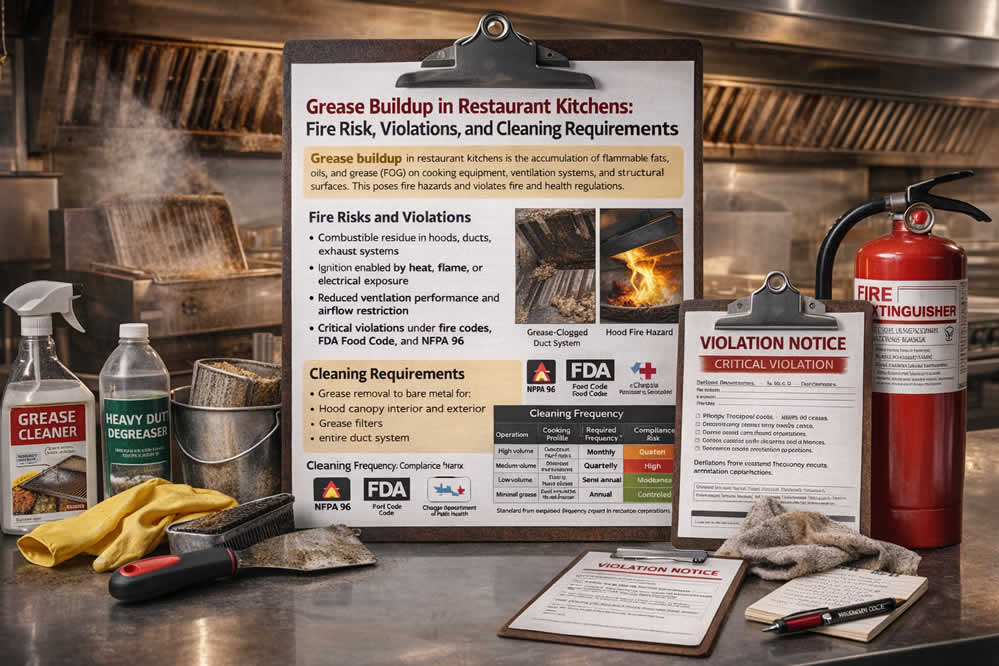
Grease buildup in restaurant kitchens is the accumulation of flammable fats, oils, and grease (FOG) on cooking equipment, ventilation systems, and structural surfaces. This accumulation creates ignition conditions, violates sanitation and fire codes, and disrupts compliant food service operations.
Grease buildup in restaurant kitchens creates fire risk, health code violations, and operational shutdown exposure by:
- Forming combustible residue in hoods, ducts, and exhaust systems
- Enabling ignition from open flame, heat, or electrical sources
- Restricting airflow and reducing ventilation performance
- Contaminating food-contact and non-food-contact surfaces
- Triggering critical violations under fire and health regulations
Entity Framework and Regulatory Basis
Grease control and cleaning requirements are enforced under:
- NFPA 96
- FDA Food Code
- Chicago Department of Public Health
These frameworks define cleaning scope, frequency, and verification requirements for commercial kitchens.
Grease Buildup Kitchen Risk Model
Grease vapor forms during high-temperature cooking processes and condenses across ventilation and structural surfaces.
Accumulation zones:
- Hood canopy interior
- Grease filters
- Horizontal and vertical ducts
- Exhaust fan assemblies
- Adjacent ceilings and wall surfaces
Risk escalation variables:
- Cooking intensity (frying, charbroiling)
- Inadequate cleaning frequency
- Poor ventilation system performance
Result: combustible layer formation with increased ignition probability.
Kitchen Fire Risk Grease
Grease acts as a sustained fuel source within enclosed ventilation systems.
Fire propagation sequence:
- Oil vaporization
- Surface condensation
- Residue accumulation
- Ignition event
- Duct-mediated fire spread
Impact:
- Fire containment failure
- Structural and equipment damage
- Operational shutdown
- Insurance exposure and liability escalation
Restaurant Hood Grease Cleaning Requirements
Cleaning must restore all system components to bare metal condition.
Required scope:
- Hood canopy (interior and exterior)
- Grease filters (removal and degreasing)
- Full duct system (horizontal and vertical runs)
- Exhaust fan and housing
Compliance condition: no visible grease residue, no combustible deposits, full airflow restoration.
Cleaning Frequency Compliance Matrix
| Operation Type | Cooking Profile | Required Frequency | Compliance Risk |
| High-volume | Continuous frying, charbroiling | Monthly | Critical |
| Medium-volume | Standard restaurant operations | Quarterly | High |
| Low-volume | Limited cooking cycles | Semi-annual | Moderate |
| Minimal grease | Non-grease-intensive operations | Annual | Controlled |
Deviation from required frequency results in violation classification.
Violation Mapping and Enforcement
Grease accumulation is categorized as a critical violation due to fire and contamination risk.
Violation triggers:
- Visible grease deposits in hood or ducts
- Clogged or saturated filters
- Missed documented cleaning intervals
- Airflow restriction due to buildup
Enforcement outcomes:
- Fines and penalties
- Reinspection requirements
- Temporary closure orders
- License suspension
Cleaning Execution Protocol
Professional restaurant hood grease cleaning requires full-system decontamination.
Execution components:
- System disassembly where required
- Industrial degreasing agents for carbonized residue
- Controlled hot-pressure washing
- Containment systems to prevent runoff contamination
- Post-clean inspection and verification
Completion standard: complete removal of grease to bare metal condition across all system components.
Quantified Risk Impact
| Risk Category | Effect of Grease Buildup | Operational Outcome |
| Fire Risk | High ignition potential | Structural damage, shutdown |
| Compliance Risk | Code violation | Fines, closure |
| Air Quality | Contaminant circulation | Unsafe working conditions |
| Equipment Performance | Reduced efficiency | Increased maintenance cost |
| Insurance Exposure | Non-compliance | Claim denial |
FAQ
What causes grease buildup in restaurant kitchens?
Oil vapor from cooking condenses on surfaces, forming combustible residue layers over time.
How often must restaurant hood grease cleaning be performed?
Frequency ranges from monthly to annually based on cooking intensity, with high-volume kitchens requiring monthly cleaning.
Is grease buildup a violation under health and fire codes?
Yes. It is classified as a critical violation due to fire hazard and sanitation risk.
Can grease buildup cause a kitchen fire?
Yes. Grease acts as a fuel source and ignites under high heat or flame conditions.
Does surface-level cleaning meet compliance standards?
No. Full-system cleaning, including ducts and exhaust fans, is required.
Service Scope
Clean Wash Remove executes full-system restaurant hood grease cleaning aligned with regulatory standards.
Service coverage includes:
- Complete exhaust system degreasing (hood, ducts, fan)
- Removal of carbonized grease deposits
- Compliance-focused deep cleaning
- Pre-inspection preparation and correction
Execution standard: restoration to bare metal condition in accordance with NFPA 96 and local health code enforcement.
Contact
Clean Wash Remove
Commercial Kitchen Cleaning Services
Website: https://cleanwashremove.com/
Service delivery aligned with: