


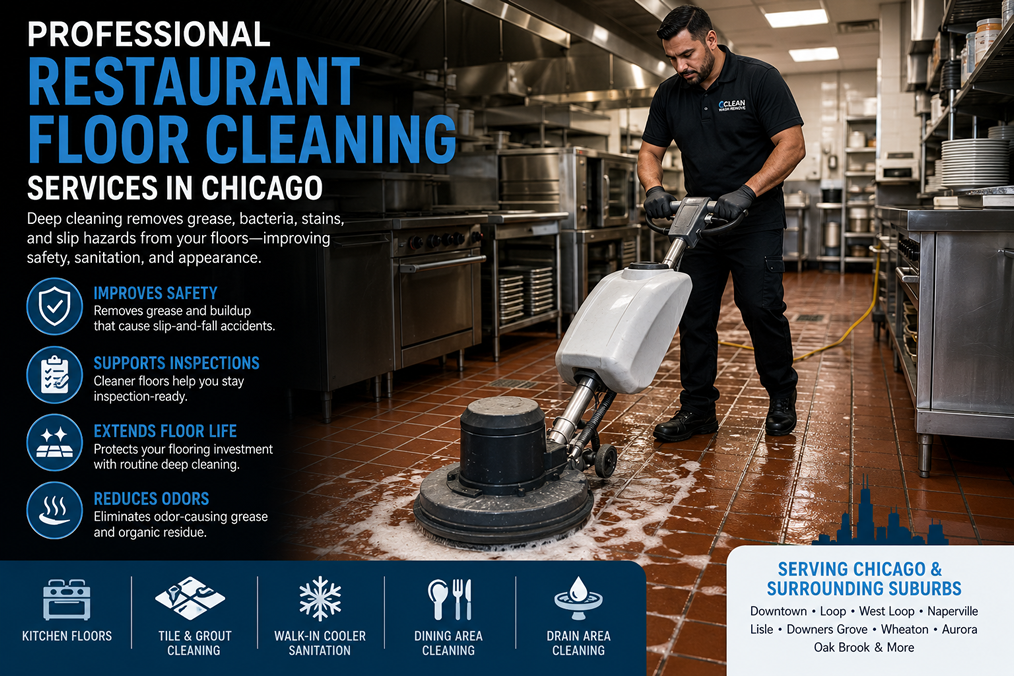
Restaurant Floor Cleaning Services in Chicago
Table of Contents
ToggleProfessional restaurant floor cleaning removes grease, food residue, bacteria, stains, biofilm, and slip hazards from commercial kitchens, food preparation areas, walk-in coolers, dining rooms, and service corridors.
What Are Restaurant Floor Cleaning Services?
Restaurant floor cleaning services are specialized commercial cleaning services that remove grease, cooking oils, food residue, bacteria, stains, biofilm, and slip hazards from restaurant kitchens, dining areas, food preparation spaces, walk-in coolers, and service corridors.
Professional technicians use industrial floor scrubbers, commercial degreasers, hot-water extraction systems, steam cleaning equipment, and professional tile and grout restoration methods to remove contamination that routine mopping cannot reach.
Embedded grease often becomes trapped inside grout joints, quarry tile, textured flooring, epoxy coatings, and concrete surfaces. Deep commercial floor cleaning improves sanitation, restores floor traction, reduces odors, extends flooring life, supports restaurant health inspection readiness, and creates a safer working environment.
Restaurants throughout Chicago, including Downtown Chicago, the Loop, West Loop, Fulton Market, River North, Lincoln Park, Wicker Park, Logan Square, South Loop, Naperville, Lisle, Downers Grove, Wheaton, Oak Brook, and Aurora, rely on scheduled floor cleaning to maintain cleaner food service environments and protect commercial flooring.
Quick Answer
Professional restaurant floor cleaning services typically include:
Why Restaurant Floors Accumulate Heavy Contamination
Restaurant kitchens operate in conditions where grease, moisture, food waste, chemicals, and continuous employee traffic create persistent contamination.
Routine mopping can remove loose debris and visible surface dirt, but it cannot extract grease and bacteria embedded beneath textured floor surfaces or inside porous grout.
Professional restaurant floor cleaning removes contaminants that traditional maintenance leaves behind, helping food service businesses maintain safer, cleaner, and more sanitary facilities.
Common Restaurant Floor Contaminants
| Contaminant | Typical Source | Operational Risk |
|---|---|---|
| Cooking grease | Fryers, grills, and cooking lines | Slip hazards |
| Fryer oil | Food production and cooking equipment | Surface deterioration |
| Food residue | Preparation stations | Bacterial growth |
| Standing water | Dishwashing areas | Mold and mildew development |
| Beverage spills | Dining rooms and service areas | Sticky flooring |
| Carbon buildup | Cooking equipment | Permanent staining |
| Organic waste | Food handling operations | Odor production |
| Cleaning chemical residue | Daily maintenance | Surface damage |
| Dirt and road salt | Customer and employee entrances | Abrasive wear |
| Grease vapors | Kitchen exhaust systems | Continuous surface contamination |
Without scheduled deep cleaning, grease penetrates grout lines and porous flooring materials. Daily maintenance becomes less effective while sanitation risks, odors, surface deterioration, and workplace hazards continue to increase.
Areas Included in Professional Restaurant Floor Cleaning
Commercial floor cleaning covers high-risk restaurant flooring from food preparation and cooking areas to customer-facing dining spaces.
Commercial Kitchen Floors
Kitchen floors experience constant exposure to grease, oil, sauces, moisture, food debris, and heavy employee traffic throughout every shift.
Professional degreasing removes embedded contamination, restores traction, and reduces slip hazards.
Tile and Grout Cleaning
Grout absorbs grease, moisture, food particles, and bacteria because of its porous structure.
Commercial degreasers, rotary scrubbers, and hot-water extraction restore tile and grout more effectively than standard mopping.
Walk-In Coolers and Freezers
Cold storage areas accumulate food residue, condensation, moisture, stains, and biofilm.
Professional cleaning removes slippery contamination without damaging commercial flooring systems.
Dishwashing Areas
Dishwashing stations are exposed to water, detergent, food residue, grease, and mineral deposits throughout daily operations.
Deep cleaning removes buildup that contributes to slippery and unsafe working conditions.
Food Preparation Areas
Preparation stations require sanitary flooring that helps reduce cross-contamination risks.
Commercial floor cleaning removes proteins, grease, bacteria, and food residue from high-production areas.
Dining Areas
Dining room floors directly influence how customers perceive the cleanliness of a restaurant.
Professional cleaning removes stains, spills, gum, tracked grease, and heavy foot traffic buildup.
Benefits of Professional Restaurant Floor Cleaning
Professional commercial floor cleaning delivers safety, sanitation, operational, and financial benefits beyond visual appearance.
Improves Employee Safety
Removing accumulated grease restores floor traction and helps reduce slip-and-fall hazards in high-traffic kitchen areas.
Supports Health Inspection Readiness
Deep cleaning reduces grease and debris beneath equipment, around drains, and throughout food preparation areas.
Extends Flooring Life
Removing grease, acids, moisture, and food residue helps protect grout, sealants, epoxy coatings, tile, and concrete surfaces.
Improves Indoor Air Quality
Old grease and organic residue can contribute to persistent kitchen odors. Deep cleaning removes odor-producing contamination.
Protects Restaurant Equipment
Scheduled cleaning reduces grease migration beneath cooking equipment, refrigeration units, and workstations.
Enhances Restaurant Appearance
Cleaner kitchens and dining areas reinforce sanitation standards and present a more professional environment.
Types of Restaurant Flooring We Clean
Professional restaurant floor cleaning can be adapted to the flooring systems commonly installed in commercial food service facilities.
- Quarry tile
- Ceramic tile
- Porcelain tile
- Epoxy flooring
- Sealed concrete
- Polished concrete
- Vinyl composite tile
- Commercial sheet vinyl
- Rubber flooring
- Anti-slip flooring
- Industrial resin flooring
- Commercial kitchen safety flooring
Each material requires the correct combination of cleaning pressure, chemicals, mechanical scrubbing, extraction, and drying procedures to remove contamination without causing avoidable surface damage.
Signs Your Restaurant Floors Need Professional Cleaning
Routine mopping is no longer sufficient when restaurant floors begin showing evidence of embedded grease, staining, or persistent contamination.
Operational Risk
Ignoring these conditions increases workplace safety risks, accelerates flooring deterioration, weakens daily sanitation efforts, and can negatively affect health inspection readiness.
Food Service Industries That Benefit From Floor Cleaning
Professional commercial floor cleaning supports restaurants and other food service facilities that manage grease, moisture, food residue, and continuous foot traffic.
Restaurants
Full-service and fast-food restaurants.
Hospitality
Hotels, bars, pubs, breweries, and event venues.
Institutional Kitchens
Hospitals, schools, universities, and corporate cafeterias.
Specialty Food Service
Bakeries, pizza restaurants, ghost kitchens, and caterers.
Food Production
Commercial food preparation and manufacturing facilities.
Entertainment Facilities
Stadium concessions, arenas, theaters, and entertainment venues.
Why Chicago Restaurants Require More Frequent Floor Cleaning
Restaurants throughout Chicago face environmental and operational conditions that can accelerate grease accumulation, floor contamination, and surface deterioration.
Professional Equipment Used for Restaurant Floor Cleaning
Professional floor cleaning requires equipment designed to remove embedded grease and contamination beyond the capability of routine mopping.
Mechanical Cleaning
- Automatic floor scrubbers
- Rotary floor machines
- Counter-rotating scrubbers
Extraction Equipment
- Hot-water extraction systems
- Commercial wet vacuums
- Industrial steam cleaners
Degreasing Equipment
- Commercial degreasers
- Foam applicators
- Tile and grout extraction tools
- Surface sanitizing systems
Drying Equipment
- Commercial drying fans
- Air movers
- Moisture extraction systems
Restaurant Floor Cleaning and Health Inspection Readiness
Professional restaurant floor cleaning supports food safety programs by reducing grease accumulation, improving sanitation, and minimizing contamination in food preparation environments.
Floor cleaning alone does not guarantee a passing inspection. It remains an important part of a comprehensive restaurant sanitation and preventive maintenance program.
Related Commercial Restaurant Cleaning Services
Restaurant floor cleaning can be combined with other commercial cleaning services to address grease and contamination throughout the facility.
Frequently Asked Questions
How often should restaurant floors be professionally cleaned?
Most restaurants benefit from monthly or quarterly deep cleaning. High-volume commercial kitchens may require more frequent service based on grease production, customer traffic, floor condition, and inspection schedules.
Does professional floor cleaning remove grease from grout?
Yes. Commercial degreasers, mechanical scrubbing, hot-water extraction, and specialized grout cleaning equipment remove embedded grease that routine mopping cannot eliminate.
Can professional floor cleaning reduce slip hazards?
Yes. Removing accumulated grease, oil, food residue, and chemical film helps restore floor traction and creates safer walking conditions for restaurant employees.
Are restaurant floor cleaning services safe for food facilities?
Professional contractors use commercial cleaning methods and products selected for restaurant and food service environments. Cleaning procedures should be matched to the flooring material and facility requirements.
What restaurant flooring materials can be cleaned?
Professional cleaning is available for quarry tile, ceramic tile, porcelain tile, epoxy flooring, sealed concrete, polished concrete, rubber flooring, vinyl flooring, anti-slip flooring, and other commercial floor systems.
Can floor cleaning help prepare a restaurant for an inspection?
Professional floor cleaning improves sanitation by reducing grease, residue, odors, and contamination around equipment, floor drains, food preparation spaces, and high-traffic kitchen areas.
Why Professional Restaurant Floor Cleaning Delivers Better Results
Professional restaurant floor cleaning removes embedded grease, bacteria, food residue, stains, and contaminants that routine mopping cannot reach.
Industrial floor scrubbers, commercial degreasers, hot-water extraction, steam cleaning equipment, and specialized restoration methods improve sanitation, restore floor traction, extend flooring life, reduce workplace hazards, and support health inspection readiness.
Restaurants throughout Chicago rely on scheduled commercial floor cleaning as part of a broader commercial kitchen cleaning, hood cleaning, kitchen exhaust cleaning, restaurant exterior cleaning, and preventive maintenance program.