


Restaurant Hood Cleaning Frequency: Direct Answer
Table of Contents
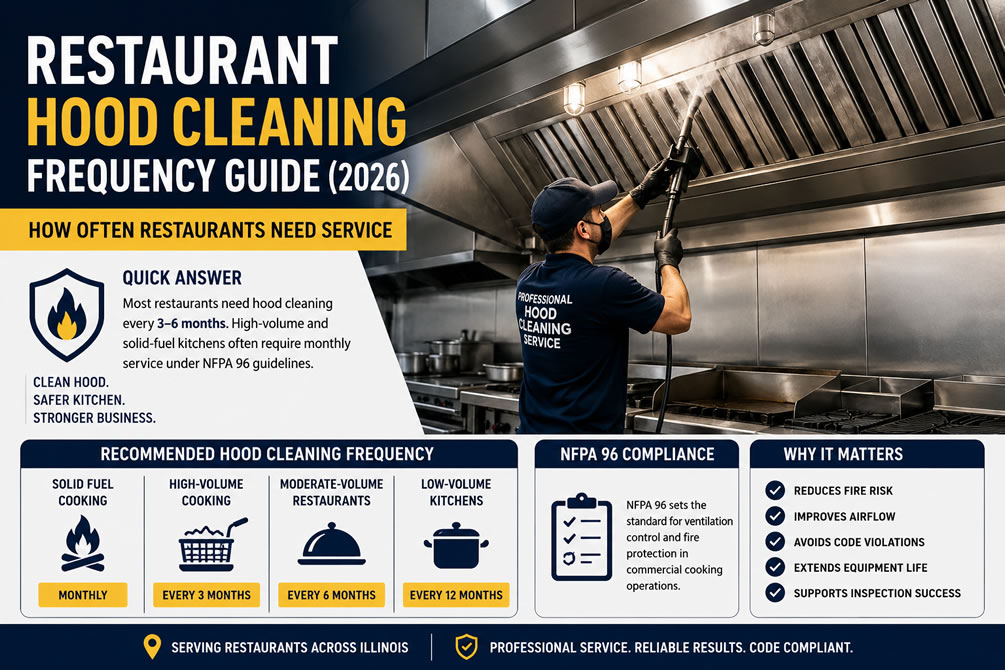
ToggleMost restaurants require professional hood cleaning every 3–6 months. High-volume kitchens and solid-fuel cooking operations often require service every month, while lower-volume kitchens may only require annual cleaning. Frequency depends on grease production, operating hours, cooking methods, and applicable inspection standards including NFPA 96.
Restaurant hood cleaning frequency is a fire prevention and compliance requirement—not a cosmetic cleaning task.
A compliant exhaust system includes:
- Hood canopy
- Grease filters
- Horizontal ducts
- Vertical duct shafts
- Exhaust fan
- Roof grease containment
Cleaning intervals apply to the entire system.
What Is Restaurant Hood Cleaning Frequency?
Restaurant hood cleaning frequency is the required interval between complete commercial kitchen exhaust cleaning services.
The objective is to remove grease accumulation before it creates:
- Fire exposure
- Airflow restrictions
- Inspection violations
- Equipment stress
- Smoke migration
- Odor retention
Cleaning schedules should be determined by operational conditions—not visible appearance.
Recommended Restaurant Hood Cleaning Schedule
| Kitchen Type | Typical Cleaning Frequency | Risk Level |
| Wood or charcoal cooking | Monthly | Very High |
| Heavy frying / high volume | Every 3 months | High |
| Standard restaurant operation | Every 6 months | Moderate |
| Low-volume kitchen | Every 12 months | Lower |
These intervals are commonly aligned with NFPA 96 hood cleaning expectations.
How Often Should Commercial Kitchen Exhaust Be Cleaned?
Commercial kitchen exhaust cleaning should occur before grease becomes measurable inside ducts.
A practical rule:
Monthly
Use when operating:
- Solid fuel cooking
- Continuous production
- High-temperature lines
Quarterly
Use when operating:
- Fast food
- Fry-heavy kitchens
- Extended operating schedules
Semiannual
Use when operating:
- Standard dine-in service
- Moderate production kitchens
Annual
Use when operating:
- Seasonal kitchens
- Limited cooking operations
Restaurants that exceed grease accumulation should shorten intervals regardless of schedule.
What Determines Hood Cleaning Frequency?
1. Cooking Output
More cooking cycles create more airborne grease.
Examples:
- Delivery kitchens
- Multi-line operations
- High-turn dining
2. Equipment Mix
Highest grease contributors:
- Fryers
- Charbroilers
- Flat tops
- Woks
- Rotisserie systems
Lower contributors:
- Steamers
- Convection ovens
- Prep stations
3. Fuel Type
Solid fuel creates the fastest contamination.
Examples:
- Wood-fired ovens
- Charcoal systems
- Open-flame cooking
4. Operating Hours
Longer operating windows compress cleaning intervals.
Most affected:
- Hotels
- Hospitals
- Airports
- Institutional kitchens
NFPA 96 Hood Cleaning Requirements Explained
NFPA 96 establishes inspection and cleaning guidance for commercial kitchen ventilation systems.
Cleaning must address the complete exhaust path.
Minimum cleaning scope:
✓ Hood interior
✓ Filters
✓ Exhaust fan
✓ Horizontal ducts
✓ Vertical ducts
✓ Access panels
Visible cleaning alone does not satisfy complete exhaust cleaning expectations.
NFPA 96 Frequency Reference
| Operation Type | Typical Interval |
| Solid fuel | Monthly |
| High volume | Quarterly |
| Moderate volume | Semiannual |
| Low volume | Annual |
These represent baseline inspection expectations and may be shortened based on observed conditions.
Hood Cleaning Requirements Illinois Restaurants Should Know
Restaurants researching hood cleaning requirements Illinois should plan for both code adoption and local enforcement practices.
Inspectors commonly review:
Exhaust System
- Grease buildup
- Duct accessibility
- Roof fan condition
Documentation
- Cleaning certificates
- Service logs
- Historical records
Fire Systems
- Suppression readiness
- Clearance maintenance
Illinois operators benefit from maintaining a documented restaurant hood cleaning schedule rather than relying on reactive service.
Kitchen Exhaust Cleaning Checklist
A complete kitchen exhaust cleaning checklist includes:
Hood
□ Degrease all interior surfaces
□ Remove residue at seams
Filters
□ Remove grease accumulation
□ Replace damaged components
Ductwork
□ Inspect horizontal runs
□ Clean vertical shafts
Fan
□ Degrease blades
□ Confirm operation
Roof
□ Remove discharge buildup
Records
□ Log cleaning date
□ Archive service documentation
Restaurant Inspection Cleaning Checklist
Inspectors typically evaluate the following areas:
□ Hood cleanliness
□ Filter condition
□ Exhaust performance
□ Duct contamination
□ Roof fan cleanliness
□ Fire suppression readiness
□ Cleaning documentation
This restaurant inspection cleaning checklist supports inspection readiness and operational continuity.
Signs Your Restaurant Needs Hood Cleaning Before the Scheduled Date
Immediate service indicators:
- Grease dripping from hood edges
- Reduced airflow
- Excess kitchen heat
- Smoke retention
- Persistent odor
- Roof grease discharge
- Sticky surfaces
- Inspection warnings
If these symptoms appear, the current cleaning interval is too long.
Hood Cleaning Near Me: What Commercial Buyers Compare
Commercial buyers searching hood cleaning near me typically evaluate:
- Full-system cleaning capability
- NFPA 96 familiarity
- Documentation process
- Before/after verification
- Service frequency planning
- Inspection support
- Emergency availability
Price alone rarely predicts compliance quality.
Restaurant Hood Cleaning Frequency Decision Table
Use this model:
| Conditions | Recommended Frequency |
| Heavy grease + long hours | Every 1–3 months |
| Moderate grease + standard hours | Every 6 months |
| Low grease + limited cooking | Every 12 months |
This model produces a practical and inspection-ready restaurant hood cleaning schedule.
FAQs
How often should restaurant hoods be cleaned?
Most restaurants require cleaning every 3–6 months, but heavy-use kitchens often require quarterly or monthly service.
Does NFPA 96 require quarterly hood cleaning?
Quarterly cleaning is commonly applied to high-volume cooking operations.
Is hood cleaning mandatory for restaurant inspections?
Inspectors frequently review hood cleanliness and service documentation.
What happens if restaurant hoods are not cleaned?
Grease accumulation increases fire risk, reduces airflow performance, and may trigger inspection findings.
What is included in professional hood cleaning?
Cleaning generally includes the hood, filters, ducts, exhaust fan, and accessible grease containment areas.